How Long Does an Allergy Test Take? What to Expect at a Skin Prick Test
A skin prick test takes minutes to set up and about 15 to 20 minutes to read. The full timeline, how to prepare, what it feels like and what the results mean.
The short answer
The skin prick test itself is short. Placing the allergen drops takes about 5 to 10 minutes, and any reaction shows up within about 15 to 20 minutes, so the results are read at the same visit. Allow extra time for your provider to go over your symptoms and medicines first and to explain the results after. Some medicines, especially antihistamines, have to be paused for days beforehand, so ask about them when you book.
Most people who book an allergy test want two answers: what they’re reacting to, and how much of their day the test will take. The second one is easy. The testing itself is short. The part worth your time is the conversation before and after it, because that’s where a list of red bumps turns into a plan.
How long each part of an allergy test takes
| Step | About how long | What happens |
|---|---|---|
| Before the test | Varies | Your provider asks about your symptoms, when and where they happen, and every medicine you take |
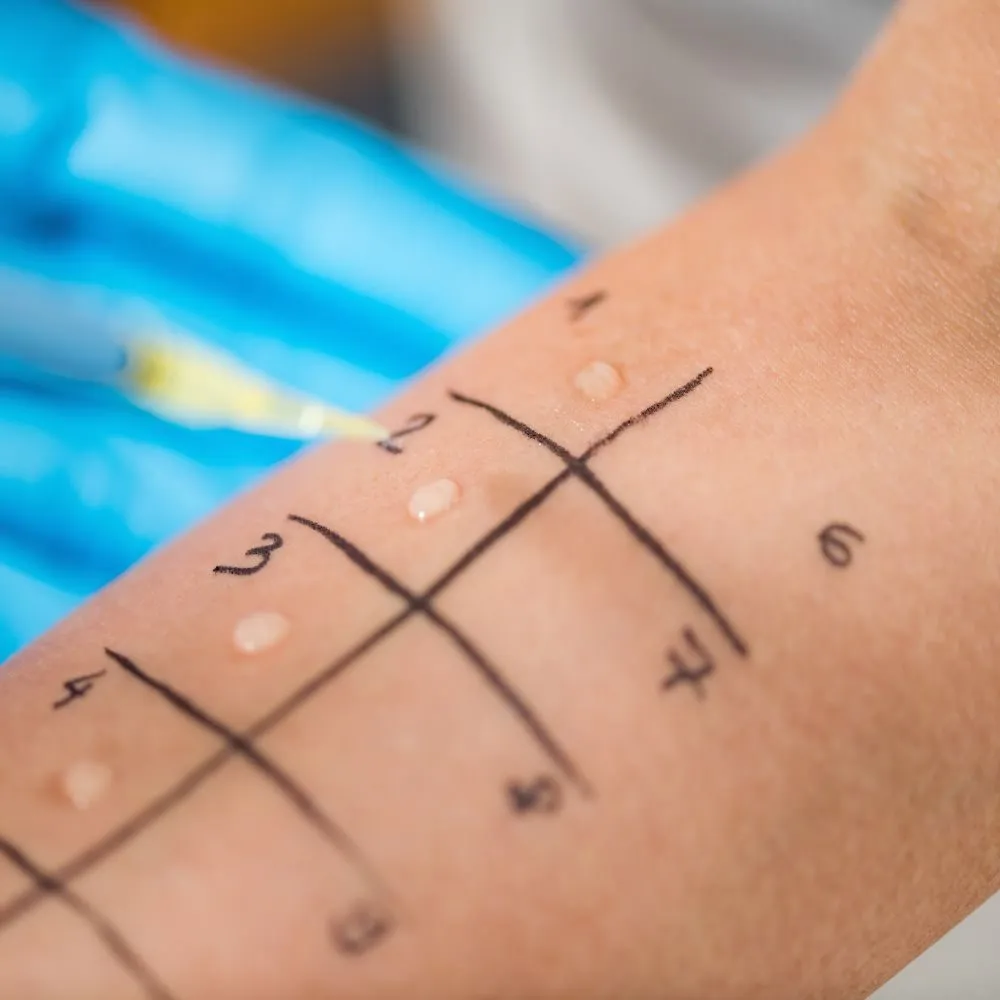
| Placing the allergens | 5 to 10 minutes | Small drops go on your forearm or back, and the skin is lightly pricked through each drop |
| Waiting for reactions | 15 to 20 minutes | Where you’re allergic, a small, raised, itchy bump called a wheal appears |
| Reading the results | Same visit | Each spot is checked and the results are explained to you |
| Afterward | Usually within 30 minutes | The bumps fade on their own |
Timings: placing the drops, the ACAAI (testing and diagnosis); the 15 to 20 minute wait, MedlinePlus (allergy skin test); fading within about 30 minutes, the AAAAI (allergy testing).
Add the two middle steps together and the test itself takes roughly 20 to 30 minutes. Allergy centers that publish their timings put the skin testing at about 30 to 40 minutes (National Jewish Health) and a first visit that includes testing at one to two hours (Johns Hopkins All Children’s Hospital). How long yours takes depends on how many allergens are tested and how much history there is to go through, so ask how much time to set aside when you book.
What happens during a skin prick test
Your provider places small drops of specific allergens on your skin, usually on the forearm or back, then lightly scratches or pricks the skin through each drop. Nothing is injected into a vein, and no blood is drawn. If you’re allergic to one of the allergens, a hive or small red bump appears at that spot within about 15 to 20 minutes (MedlinePlus).
Two control spots go on at the same time. One has histamine, which makes almost everyone’s skin react; the other has plain salt water (saline), which shouldn’t. Your reactions are read against those two, and if the histamine spot barely reacts, something such as an antihistamine may be muffling the test (AAAAI/ACAAI practice parameter).
Because the reactions show up so quickly, the results are read before you leave. That is the main practical difference from an allergy blood test, which has to go to a laboratory.
Does an allergy skin test hurt?
Not much. In the words of MedlinePlus, “The test itself is not painful.” The most common side effect is red, itchy skin where you reacted, and the itch is usually the part people remember (MedlinePlus). The AAAAI describes the test as relatively painless, with a positive spot that looks and feels like a mosquito bite (AAAAI).
The test is very safe, but not risk-free. In very rare cases, a skin test can set off a severe allergic reaction (anaphylaxis), which is why it’s done in a provider’s office where emergency equipment is on hand.
How to prepare for an allergy test
Ask about your medicines when you book. Antihistamines block the very reaction the test looks for, so they usually have to be stopped for several days beforehand. MedlinePlus lists antihistamines and certain antidepressants among the medicines you may need to pause, and says your provider will tell you which ones and for how long (MedlinePlus).
Sources don’t agree on the exact number of days. One ACAAI page says to stop antihistamines 3 to 7 days before testing (ACAAI); its questions-and-answers page says at least 7 days for most of them, 10 days for hydroxyzine, and as little as 48 hours for diphenhydramine (Benadryl) (ACAAI). That’s why you get a list for your own medicines rather than one rule for everyone.
Don’t stop everything. Asthma inhalers and steroid nasal sprays generally don’t affect the test (ACAAI). Some antidepressants and other psychiatric medicines can dull the results, but they should never be stopped without the doctor who prescribed them. If you take a beta-blocker for your heart or blood pressure, say so: it doesn’t change the results, but it matters for safety if you have a strong reaction (ACAAI).
On the day, bring your medicine list and wear a short-sleeved top, so your forearm is easy to reach.
How to read allergy skin test results
A raised bump where an allergen was placed is a positive reaction. Allergy specialists generally count a bump as positive when it is at least 3 millimeters wider than the saline spot, read at the same time (practice parameter). A bigger reaction makes an allergy more likely, but it isn’t a measure of how severe a reaction would be (AAAAI).
A positive result means your immune system makes allergy antibodies to that allergen. It doesn’t prove that the allergen is what’s causing your symptoms. That’s why testing starts with your history: the AAAAI says testing should be prompted by the patient’s history (AAAAI). A strong reaction to dust mites matters a lot if you wake up congested every morning, and much less if your only symptoms come outdoors in spring.
The opposite also happens. At least one in three people with nasal symptoms don’t have allergies at all (AAAAI), and testing can help show when the cause is something else.
For foods, the rule is stricter. A positive skin or blood test to a food shows only that your body makes IgE antibodies to it: “Blood and skin tests alone cannot be used to diagnose food allergy,” in the NIH’s words (NIAID).
What a South Florida allergy panel looks for
Which allergens you’re tested for depends on your symptoms and history, but in Florida a few culprits come up again and again. Florida’s pollen seasons are more frequent and longer than in most of the country (UF/IFAS):
- Trees, especially oak. Trees make about 80% of Florida’s airborne pollen, and in South Florida the season peaks from February to May (UF/IFAS News).
- Grasses. Bahiagrass is the state’s most abundant grass and one of its most allergenic, and Bermudagrass can pollinate year-round in subtropical Florida.
- Weeds, led by ragweed. Goldenrod is often blamed, but wrongly.
- Dust mites, which thrive in warm, humid bedding, carpet and upholstered furniture (AAAAI).
- Mold, which grows wherever there’s moisture: leaks, flooding, damp rooms. The CDC advises keeping indoor humidity no higher than 50% (CDC).
When a blood test is used instead
An allergy blood test measures the IgE antibodies your body makes to one allergen at a time. Your provider may order one if you have certain skin conditions, take medicines that would affect a skin test, or are likely to have a serious reaction to the allergens used in skin testing. It’s sometimes used for young children, for whom skin testing may be too uncomfortable (MedlinePlus).
The trade-off is time. The blood goes to a laboratory, so results take longer than a skin test, and allergy blood tests can sometimes show an allergy you don’t actually have. At Ambert, blood is drawn at the office and sent to an outside lab; see blood work and lab tests.
After the results: avoid it, treat it, or retrain it
Once you know your triggers, there are three broad options, often used together:
- Avoid what you can. Fixing leaks and keeping indoor humidity low helps control mold (CDC), and dust mites are easier to manage once you know they’re the problem.
- Treat the symptoms. Antihistamines and nasal sprays work, but only while you keep taking them.
- Treat the allergy itself with allergy shots. Shots give you gradually larger doses of the allergens you tested positive to, so your immune system becomes less sensitive over time. A build-up phase of about four to six months is followed by maintenance shots every two to four weeks, usually for three to five years (AAAAI). Because most serious reactions start within 30 minutes, the AAAAI strongly recommends waiting in the office for 30 minutes after each shot (AAAAI). Shots are used for pollen, dust mite and other environmental allergies and for insect stings, not for food allergies.
Allergy testing at Ambert
Skin prick testing and allergy shots are done at the Miami Lakes office, by the same providers who handle your primary care, and the results are read at the same visit. The allergy testing and allergy shots page covers the program in full. If your allergies also affect your breathing, see asthma, COPD and lung care.
Call the office to book, and ask which of your medicines to pause and for how long. Testing is done at both the Miami Lakes and Kendall offices. New patients can start with the new patient guide, and the insurance page explains coverage.
Common questions
-
Is allergy testing covered by insurance?
Usually, when there's a medical reason for it, but the rules depend on your plan, so check whether you need a referral. For Medicare patients in Florida, the regional Medicare contractor's coverage policy for allergy testing (LCD L33261) expects the number of tests to fit your history, and it doesn't cover routine yearly testing without a clear reason, or IgG "food sensitivity" tests. The office can check your coverage before you book.
-
How long do I need to stop antihistamines before an allergy test?
Usually several days, and the exact time depends on the medicine. The American College of Allergy, Asthma and Immunology (ACAAI) generally advises stopping antihistamines 3 to 7 days before testing, and a few, such as hydroxyzine, need longer. Your provider will tell you what to stop and when. Never stop a prescription medicine, such as an antidepressant, without asking the doctor who prescribed it.
-
Can children have an allergy skin test?
Yes. The ACAAI says children of any age can have allergy testing, though skin prick testing is rarely done in babies younger than 6 months. For some young children a blood test is used instead, because skin testing may be too uncomfortable for them.
-
How accurate is an allergy skin test?
Fairly accurate for airborne allergens such as pollen and dust mites, but not perfect. In studies that compared skin prick tests with nasal allergen challenges, the skin test caught about 85 to 87 of every 100 people who truly reacted, and was correctly negative in about 79 to 86 of every 100 who didn't, according to the allergy testing practice parameter. That's why the results are always read alongside your symptoms.
-
Can a skin prick test diagnose a food allergy?
Not on its own. A positive test shows only that your body makes IgE antibodies to that food. The NIH's food allergy guidelines say blood and skin tests alone can't diagnose a food allergy, and that you don't have one unless you also have symptoms. A supervised food challenge is the only test that can confirm it.